Coffee Bean Size for Pour-Over: Identify & Adjust
By Santiago Alvarez • 11th Mar
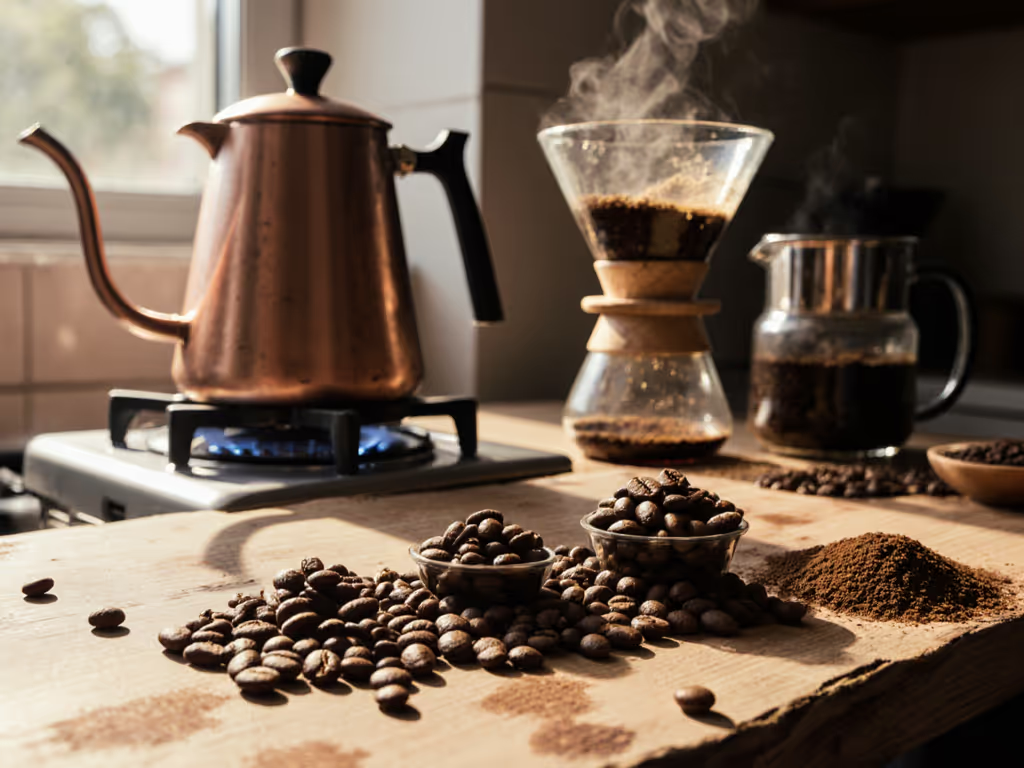
When you're dialing in a pour-over recipe, the conversation usually centers on coffee bean size, pour over performance, and grind adjustment, but bean size itself, before grinding, sets the trajectory for everything that follows. Whole beans vary in density, porosity, and surface area, which directly influence how they fragment during grinding and, ultimately, how they extract in your cup. If you're puzzled by inconsistent results despite following the same recipe, the beans themselves may be the variable you've overlooked.
The relationship between bean size, grind consistency, and extraction is where recipes either stabilize or drift. I've spent weekends testing this exact fault line, running nine brews across three water profiles (tap at 220 ppm, filtered, and a mineral recipe) while swapping dripper types but holding bean origin constant, then repeating with different bean sizes from the same roaster. If your tap water is similar, see our pour-over water guide for simple mineral fixes and better consistency. The data revealed a fact rarely acknowledged in online recipes: smaller, denser beans grind more uniformly than larger, more porous ones under the same burr geometry. One Monday morning I replicated those weekend results with a fresh grind and fresh water (clarity and sweetness held firm). That consistency is the point.
What Is Bean Size, and Why Does It Matter for Pour-Over Brewing?
Before grinding happens, whole coffee beans themselves vary measurably. A bean's porosity, and therefore pour-over outcome, depends on its size and density. Smaller beans from certain high-altitude terroirs tend to be denser and less porous, while larger beans from lower altitudes may be less dense and less forgiving under uneven grinding. This variation cascades into your grind.
When a dense, smaller bean enters your burr set, it fragments into particles of more uniform size because there's less structural variance to exploit. A larger, more porous bean may shatter unevenly, producing fines (very small particles) and unbroken chunks at the same grind setting. That unevenness is your extraction problem, not necessarily the average grind size itself. According to coffee research cited by Perfect Daily Grind, grind size uniformity is more important than grind size itself; a consistent grind promotes even extraction, allowing flavors to emerge cleanly rather than chaotically.
Bean shape and density also affect how water distributes through the coffee bed. Denser beans, after grinding, pack slightly differently than porous ones, changing permeability and brew time subtly. Test the claim, change one variable, trust your cup.
How Does Bean Density and Porosity Affect Grind Quality?
Here's where dense bean extraction becomes a practical issue. A denser bean requires more grinding energy to break apart, which can generate heat in manual grinders and lead to fines if your burr spacing is tight. Conversely, a porous bean fragments more easily but may produce larger, lighter particles that fall out of suspension during the bloom and early pours, leaving gaps in the coffee bed.
When you grind a batch of beans with mixed density and porosity, your grinder is trying to produce a target average size (say, medium-fine, 400 to 700 microns for a V60, per industry standards). But particles are ranging wider: some are 250 microns (overextraction), others are 800 microns (underextraction). You get a chaotic brew with conflicting flavors: sour fruit notes colliding with bitter tannins in the same cup.
This is why a single brew time or water temperature doesn't rescue a bad grind distribution. Uniformity is the load-bearing variable. If your beans are consistently smaller and denser, you'll achieve tighter particle distribution from the same grinder, yielding cleaner extraction at identical settings compared to larger, porous beans. Claims require receipts: test two bags from different roasters (one small/dense, one large/porous) at the same grind setting and brew ratio (1:16 water-to-coffee). Compare brew times and taste. Differences will be audible in the cup.
What Grind Size Should I Use, and How Does Bean Size Influence It?
Most pour-over guidance recommends medium to medium-fine grind (similar to fine table salt, or 400 to 700 microns depending on dripper). For brewer-specific targets and adjustments, use our grind size dialing guide. But that baseline assumes a "normal" bean: medium-sized, moderate density. Here's where it breaks down:
- Smaller, denser beans: You may achieve your target grind size with slightly tighter burr spacing or more grinding time. The result? Faster, tighter particle distribution and less fines production. Brew time often runs 30 to 45 seconds faster than the baseline.
- Larger, porous beans: You'll hit your target grind size more quickly, but the particle spread is wider. Fines settle faster; larger pieces linger. Brew time may run longer or stall unexpectedly.
If you've dialed in a recipe around a single origin and then switch to a different bean (especially from a different elevation or terroir), the coffee's physical properties change. Your grind setting (number of clicks on a manual grinder) no longer maps to the same extraction window. A 1Zpresso K-Ultra set to 85 clicks may work beautifully for a dense Ethiopian natural, but the same setting on a larger, less dense Brazilian may over-extract because particles are less uniform and fines accumulate faster.
The practical fix: bean size grind adjustment is not a one-time setting. When you change beans, reset your hypothesis. Brew a small test batch (say, 20g beans to 320g water) at your standard setting, then taste. If sour, the grind is too coarse relative to this bean's properties (go finer). If bitter or slow, grind coarser. Observe one variable at a time; log your settings and results.
How Do I Identify Bean Size and Density Visually?
You don't need a scale or caliper; observation suffices. When you first open a bag of whole beans, look at the visual scatter: Are the beans roughly uniform in size, or is there obvious range (some fat, some smaller)? Density is harder to judge before grinding, but you can infer it from the roast's appearance and origin. Beans roasted to a light color from high-altitude origins (Ethiopia, Kenya, Colombia 1600+ meters) tend to be smaller and denser. Brazilian naturals and lower-altitude beans are often larger and less dense.
Once you grind a small handful (by hand, if you have a hand grinder, to preserve burr wear), look at the particle spread under bright light. Do particles look consistent in size, or is there a range from fine dust to visible chips? Consistency = easier extraction; range = extraction chaos coming. This visual check takes 10 seconds and saves you from dialing into a grind that's fighting the beans' structure. It is quick insurance.
How Does Bean Size Relate to Different Pour-Over Drippers?
Different dripper geometries reward different grind profiles. A V60's cone shape promotes fast drainage, so a medium-fine grind (and higher grind consistency pour over uniformity) is essential. A Kalita Wave's flat bottom naturally slows flow, so a medium grind suffices. A Chemex's thick filter restricts flow, requiring coarser grind to avoid stalling. For a deeper dive into cone vs flat-bottom extraction, see our geometry comparison.
But here's the wrinkle: if your beans are small and dense, they'll produce a tighter grind distribution at any given setting. Brew time will be predictable. If your beans are large and porous, the same dripper and grind setting may produce variable brew times because fines and particle size scatter compound. This means smaller beans are more forgiving across different drippers, they adapt better because their grind distribution is tighter. Larger beans demand more attention to grind setting and require more frequent adjustment between batches.
If you're new to pour-over and want a stable weekday routine, prioritize consistency within your bean selection before upgrading grinders or drippers. Stick with one origin or roaster for two weeks; dial in one recipe. Once that's locked, switch beans intentionally and observe the adjustments needed. You'll build intuition fast.
What Brew Parameters Should I Adjust If Bean Size Is the Issue?
When you've identified a mismatch between your beans and your current grind setting, adjustment protocol is straightforward: test the claim, change one variable, trust your cup.
- If brew tastes sour: Grind finer (target smaller particles, slower flow, more extraction time). If already fine, extend the bloom time from 30 to 45 seconds to allow denser beans to hydrate fully.
- If brew tastes bitter or stalls: Grind coarser (faster flow, less extraction). If already coarse, reduce water temperature by 5°F and shorten total brew time to 2:45 from 3:15.
- If brew lacks clarity or tastes muddy: Increase grind consistency (use a burr grinder with wider grind range if your current grinder is limited). Porous beans may require a slightly coarser setting than you'd expect to avoid fines accumulation.
Keep a log: bean origin, bag date, grind setting, bloom time, water temperature, total brew time, and flavor notes. Over two or three bags, patterns emerge. You'll notice, for instance, "Ethiopian naturals need 5 clicks finer than Brazilian naturals on my grinder," or "This roaster's beans take an extra 10 seconds bloom."
Brew time targets are typically 2:45 to 3:30 for a standard 1:16 ratio pour-over. If you're consistently outside that window, bean size variance is likely the culprit.

Final Verdict: Controlling Bean Size for Repeatable Pour-Over
Coffee bean size pour over performance boils down to a single principle: smaller, denser beans produce tighter grind distributions, faster brew cycles, and more predictable extraction. Larger, porous beans are less forgiving and demand tighter grind control and more frequent adjustment.
For a stable weekday pour-over routine, source beans with consistent sizing and moderate density. Light-roasted, high-altitude origins tend to deliver this. Once you've locked a recipe around one bean, switching origins is a deliberate experiment, not a random act. When you change beans, reset your grind setting and re-dial across two test brews before committing to a full morning cup.
The mastery isn't in owning the fanciest grinder; it's in recognizing that bean size matters, measuring it through grind consistency, and adjusting one variable at a time until clarity and sweetness align with your cup. Track results, replicate Monday morning, and trust the data. That's where recipes survive reality.
Related Articles
Brewing Techniques & Coffee Science
Dense Bean Extraction: Control Your Pour Over Variables
24th Apr•7 min read
Brewing Techniques & Coffee Science
High-Sugar Coffee Beans: Pour-Over Extraction Guide
12th Apr•8 min read
Brewing Techniques & Coffee Science
High TDS Water Pour Over: Flow & Extraction Guide
31st Mar•7 min read